For years, customer support leaders faced a rigid trade-off: you could offer personalized, high-touch support, or you could offer fast, automated scale. You rarely got both.
Early chatbots promised to fix this but often delivered frustration—rigid decision trees that failed the moment a customer went off-script. Today, the technology has matured. We have moved from simple “chatbots” that talk, to Conversational AI Platforms that act.
But with hundreds of vendors claiming “AI” capabilities, what actually constitutes an enterprise-grade platform?
A Conversational AI Platform is a comprehensive software suite that enables businesses to build, deploy, and manage intelligent virtual agents across voice and digital channels. Unlike a standalone chatbot, a platform includes the infrastructure for Automatic Speech Recognition (ASR), Natural Language Understanding (NLU), and—crucially—backend integration to execute tasks, not just answer FAQs.
(Note: If you are looking for a breakdown of the underlying technology—how NLU and NLP work scientifically—read our deep dive: What is Conversational AI?)
This guide explores what features define a true platform, how to evaluate architecture, and how this technology solves the scaling challenges of modern contact centers.
The 3 Core Pillars of a Modern AI Platform
A true platform is more than just a listening engine. To drive genuine efficiency, it must handle the entire lifecycle of a customer interaction. When evaluating solutions, look for these three distinct layers working in unison.
1. The Cognitive Layer (The Brain)
This is the “AI” component most people recognize. It uses Natural Language Understanding (NLU) to decipher intent from messy human speech or text.
- Sentiment Analysis: Detecting if a customer is frustrated or urgent in real-time.
- Entity Extraction: Pulling specific data (dates, order numbers, currency) from a sentence.
- Context Retention: Remembering that “it” refers to the flight mentioned two minutes ago.
2. The Orchestration Layer (The Nervous System)
This is where most non-native solutions fail. Intelligence is useless if it is disconnected from your customer data. The orchestration layer connects the AI to your system of record (e.g., Salesforce).
- Identity Management: Recognizing the caller based on their phone number and CRM profile.
- Data Retrieval: Pulling up the customer’s recent order history before the conversation starts.
3. The Execution Layer (The Hands)
We are entering the era of Agentic AI. The platform shouldn’t just retrieve data; it should manipulate it.
- Workflow Triggering: Updating a case status, processing a refund, or scheduling a callback.
- Handover Protocols: If the AI cannot solve the issue, it must pass the full transcript and context to a human agent, ensuring the customer never has to repeat themselves.
Key Features to Look For: A Buyer’s Checklist
When evaluating a Conversational AI platform, look beyond the marketing hype. The following features differentiate an enterprise-ready asset from a basic tool.
True Omnichannel Support
Your customers do not live in a single channel. A robust platform manages conversations across voice (telephony), web chat, SMS, and social apps (like WhatsApp) from a single interface. Crucially, the context must travel with the customer. If they start on chat and escalate to voice, the AI should know exactly where the conversation left off.
No-Code Asset Builders
Operational agility is critical. You cannot wait weeks for IT or a vendor to update a call flow. Look for platforms that offer a drag-and-drop studio, allowing operational champions to adjust prompts, change routing logic, and update policies instantly without writing code.
Real-Time Observability
You cannot improve what you cannot measure. A platform must provide granule visibility into AI performance:
- Deflection Rates: How many queries are fully resolved without humans?
- Fall-Back Rates: Where is the AI failing and handing over to humans?
- Sentiment Tracking: Is the AI making customers happier or angrier? 7
Why Architecture Matters: Native vs. Integrated
For Salesforce-centric organizations, the most critical decision is architectural: Native vs. Non-Native.
Most Conversational AI platforms are third-party clouds that “integrate” with Salesforce via API. This means your customer data leaves your secure Salesforce environment, travels to the vendor’s cloud for processing, and then travels back.
The Risks of Non-Native Architectures:
- Latency: Data travel time creates awkward pauses in voice conversations.
- Data Sovereignty: Your customer data is stored in a third-party database, doubling your security surface area.
- Sync Errors: API limits or failures can result in missing data or broken workflows.
The Salesforce-Native Advantage
A Salesforce-native solution lives entirely within your existing trust boundary. No data leaves your org. The AI has direct, zero-latency access to any object, field, or record in your CRM. This architecture satisfies the rigorous demands of technical validators concerned with governance limits and data security.
The Business Case: Solving Linear Scaling Constraints
The primary driver for adopting a Conversational AI platform is usually simple math. Traditional contact centers suffer from linear scaling constraints: as your customer base grows, your support costs grow in lockstep because you must hire more human agents.
A platform breaks this link. By automating high-volume, repetitive queries (like “Where is my order?” or “Reset my password”), you increase your capacity to serve customers without increasing headcount.
This improves your Cost-to-Serve and frees your human agents to focus on high-value, complex, or empathetic interactions—the work that actually builds customer loyalty. It transforms support from a cost center into a scalable operation.
Conclusion: From Passive Tool to Active Workforce
The definition of a Conversational AI platform has shifted. It is no longer enough to simply understand text. The standard for 2026 is a system that can listen, understand, and act securely within your business systems.
If you are running your operations on Salesforce, the architecture you choose dictates your success. A native platform ensures that your AI is not just a chatbot bolted onto the side of your business, but a fully integrated member of your team.
Ready for a Conversation?
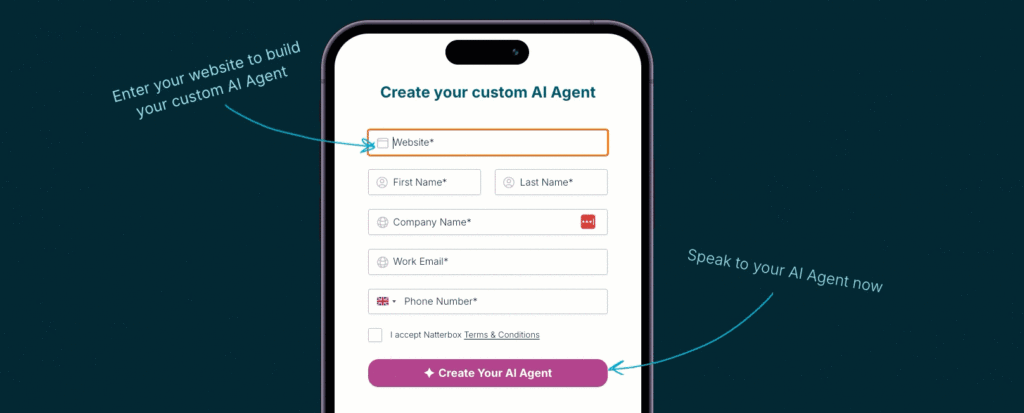
Of course, a must-have for Conversational AI Platforms is conversation quality. Enter your business website to hear the quality of conversation you can expect from a Natterbox AI Agent. Within 60 seconds, you’ll be able to phone in and have a real conversation. Role-play as a customer or a lead for your business, and hear it in action.