The “Sticker Price” Trap: Why Your Agentic AI Pricing Model Matters More Than the Rate
For a Director of Customer Support, the promise of Agentic AI is simple: break the linear relationship between revenue growth and headcount costs. You need to handle 20% more volume without hiring 20% more agents.
But if your AI pricing model is misaligned, you might just trade one linear cost for another.
As you build your business case for 2026, you will encounter a fractured market of pricing models. Some promise low barriers to entry; others promise predictability. Understanding the difference (and the hidden “taxes” in each) is the difference between a defensible budget and an awkward conversation with your CFO next quarter.
The Real “Agentic AI Costs”: A Breakdown
When evaluating vendors, you aren’t just buying software; you are buying a cost structure. In 2026, the market has settled into three dominant models.
1. The Consumption Model (Pay-Per-Conversation)
Initially popularized by major platforms and various API-first startups, this model charges you a set fee for every interaction or “turn” the AI handles.
- The Allure: Low barrier to entry. You only pay for what you use. If you have zero calls, you pay zero.
- The Trap: It preserves the Linear Scaling Constraint. If your marketing team launches a successful campaign and call volume triples, your AI bill triples. You are effectively paying “overtime” to a robot. There is no economy of scale; the 1,000,000th conversation costs exactly the same as the first.
2. The Token-Based Model (Pay-Per-Process)
Common with non-native, “wrapper” solutions that rely heavily on third-party LLMs (like OpenAI or Anthropic). You pay for the computing power (tokens) used to generate answers.
- The Allure: Granular precision.
- The Trap: Bill Shock. A “hallucinating” AI that gets stuck in a loop or a complex customer query that requires long explanations can burn through budget instantly. It is nearly impossible to forecast accurately.
3. The License/Capacity Model (The Predictable Asset)
This model charges a flat fee for the “digital worker” or the capacity to handle concurrent interactions, regardless of total volume.
- The Logic: This treats AI as an asset, not a utility.
- The Advantage: It breaks the linear cost curve. If you pay a flat rate for an AI Agent and optimize it to handle 50% more calls, your Cost Per Contact (CPC) drops significantly. You are rewarded for efficiency, not penalized for volume.
The Hidden Cost: The “Non-Native Tax”
Beyond the sticker price, there is a secondary layer of costs that rarely appears on the initial quote but significantly impacts EBITDA. This is the “Integration Tax” faced by non-Salesforce-native solutions.
If your AI solution lives outside Salesforce, every piece of data it needs (customer names, order history, case details) must be fetched via API.
- Middleware Costs: You may need to purchase and maintain middleware (like MuleSoft or Jitterbit) just to connect the “brain” to the data.
- Data Latency: The time cost of fetching data creates lag, increasing Average Handle Time (AHT).
- Maintenance Drift: Every time your Salesforce Admin adds a custom field, the non-native integration breaks, requiring expensive professional services to fix.
The Natterbox Difference: Because we are 100% Salesforce-native, we eliminate this tax. There is no API metering for data egress and no middleware to maintain. Your data stays within the trust boundary, reducing both security risk and total cost of ownership (TCO).
Scripting Capabilities: The operational “Soft Cost”
The final component of the cost equation is speed to value.
Many “enterprise” AI solutions require a team of engineers or a six-figure Professional Services contract to script, deploy, and update agents. If you need to change a script because of a sudden product recall, and it takes two weeks and a change order to do it, the “cost” of that delay is measurable in failed customer interactions.
Look for solutions with a No-Code / Low-Code Policy Builder. The ability for a Support Manager to drag-and-drop a new routing logic or update an AI response instantly (without IT) is a massive deflector of operational cost.
Calculating Your True Cost-to-Serve
To present a winning case to your Board, move the conversation away from “How much is the license?” to “What is the blended cost per contact?”
- Scenario A (Human): $60k salary / 15,000 contacts = $4.00 per contact.
- Scenario B (Consumption AI): Fixed rate = $2.00 per contact (Forever).
- Scenario C (Capacity AI): $X Flat Fee / Increasing Volume = Declining cost per contact.
For high-velocity businesses, predictability is king. Choose the model that rewards your growth, rather than taxing it.
Ready for a Conversation?
Natterbox’s AI Workforce is 100% native and priced per seat. Try it out for yourself in just 60 seconds.
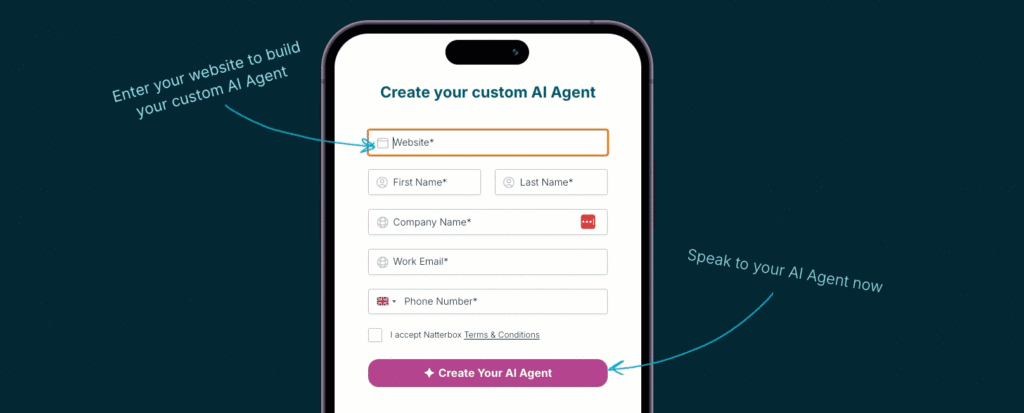
Enter your business website to activate your custom AI Agent. Within 60 seconds, you’ll be able to phone in and have a real conversation. Role-play as a customer or a lead for your business, and hear it in action.