In 2026, the question isn’t if you need a contact center solution integrated with Salesforce. It’s how deep that integration goes.
When evaluating Salesforce contact center solutions in 2026, the friction points are no longer just about call quality or basic routing. They are about data silos. When your voice data lives in one cloud and your customer data lives in another, your agents waste time toggling screens, your reports are permanently out of sync, and your AI can’t see the full picture.
The market is crowded with “integrations”—external apps that plug into Salesforce via an API. But true “native” solutions are rare. This guide compares the top 12 contact center solutions for Salesforce, scoring them on Architecture (Native vs. Connector), AI Maturity, Setup Velocity, and Total Cost of Ownership (TCO).
The Evaluation Framework
To provide a fair comparison, we evaluated each solution against the specific needs of a Salesforce-centric support or sales team:
- Salesforce Native Score: Is the app built inside Salesforce, or does it just talk to it? (1 = Connector / 10 = Fully Embedded).
- AI Maturity: Does it offer basic transcription, or true Agentic AI that automates workflows?
- Setup Velocity: Can you deploy in days, or does it require a 6-month consulting engagement?
- Data Sovereignty: Does voice data leave your Salesforce org? (Critical for GDPR/Compliance).
- TCO (Total Cost of Ownership): We look beyond the license fee to include implementation costs, maintenance overhead, and the financial impact of efficiency gains (EBITDA).
1. Natterbox
The Fully Native, Intelligent Voice Platform for Salesforce
Natterbox is designed for teams who view Salesforce as their single source of truth. Unlike others that act as external “wrappers” or simple carriers, Natterbox is built entirely within the Salesforce environment.
This distinction is critical as the market shifts toward Salesforce Voice. While other providers essentially act as a “dumb pipe” plugging into Salesforce, Natterbox provides the Intelligence Layer natively inside the CRM.
This means 100% of your routing logic, data, and AI agents live inside Salesforce, not in a third-party cloud. The result is zero data latency, no synchronization errors, and the ability to modify workflows instantly without IT help.
Best For: Mid-market to Enterprise teams (200–5,000+ employees) prioritizing Salesforce data integrity and rapid AI adoption.
Key Advantage: Native Agentic AI. Because the “brain” of the system is inside Salesforce, Natterbox AI Agents can autonomously update records and trigger workflows in real-time, something external connectors struggle to do securely.
Natterbox Scorecard
| Parameter | Score | Notes |
| Architecture | 10/10 | 100% Native. No external app required. |
| AI Capabilities | 9.5/10 | Full Agentic AI across Voice and Digital, automated coaching via AI Advisor. |
| Setup Velocity | 9/10 | “Clicks not code” policy builder. |
| Voice Quality | 9/10 | Global low-latency infrastructure. |
| TCO / Value | 10/10 | Effectively breaks the link between contact center capacity and headcount. |
Learn more: How Natterbox AI Agents automate L1 queries
2. Amazon Connect (AWS)
The Pay-As-You-Go Builder’s Kit
Amazon Connect disrupted the market with its consumption-based pricing and massive scalability. It is a powerful, “serverless” contact center that appeals to technical teams who want to build custom solutions from scratch.
- Best For: Large enterprises with heavy developer resources who want to build a bespoke contact center.
- The Trade-off: It is not a ready-to-use product. It is a set of building blocks. To get it to work seamlessly with Salesforce, you often need significant developer time or a third-party overlay.
- Salesforce Native Score: 6/10 (Requires CTI adapter).
Amazon Connect Scorecard
| Parameter | Score | Notes |
| Architecture | 6/10 | External cloud connected via CTI adapter. |
| AI Capabilities | 8/10 | Strong (Lex/Polly), but requires configuration. |
| Setup Velocity | 4/10 | High complexity; requires dev resources. |
| Voice Quality | 8/10 | Reliable AWS backbone. |
| TCO / Value | 7/10 | Low license fees, but high “hidden” developer costs. |
3. Genesys Cloud CX
The Enterprise Heavyweight
Genesys is a leader in the Gartner Magic Quadrant and a powerhouse for massive, multi-channel global contact centers. It offers deep functionality for workforce management (WFM) and omnichannel routing.
- Best For: Massive global enterprises (5,000+ agents) where voice is just one of many complex channels.
- The Trade-off: Complexity and cost. Genesys is a platform you “move to,” not one that fits into your existing Salesforce architecture. Implementation often takes 6–12 months.
- Salesforce Native Score: 5/10 (External platform with sync).
Genesys Scorecard
| Parameter | Score | Notes |
| Architecture | 5/10 | Separate platform; data sync required. |
| AI Capabilities | 9/10 | Deep predictive routing and AI. |
| Setup Velocity | 3/10 | Long deployment cycles (months/years). |
| Voice Quality | 9/10 | Excellent global stability. |
| TCO / Value | 4/10 | High license & implementation costs. |
4. Five9
The Traditional Cloud Leader
Five9 is one of the oldest and most recognized names in CCaaS (Contact Center as a Service). They have a robust feature set and a long history of integrating with Salesforce.
- Best For: Organizations moving from on-premise hardware to the cloud who want a “safe,” traditional choice.
- The Trade-off: It is a separate application. Agents must log in to Five9 separate from Salesforce, and data syncing can face API governor limit issues during high volume.
- Salesforce Native Score: 6/10 (Integrated, not embedded).
Five9 Scorecard
| Parameter | Score | Notes |
| Architecture | 6/10 | Integration layer; risk of API limits. |
| AI Capabilities | 7/10 | Strong IVA, but often requires extra modules. |
| Setup Velocity | 5/10 | Moderate; distinct separate system. |
| Voice Quality | 8/10 | Reliable, established network. |
| TCO / Value | 6/10 | Standard enterprise pricing structure. |
5. Talkdesk
The User-Experience Choice
Talkdesk gained market share by focusing on ease of use and a modern, clean interface compared to legacy providers like Avaya or Cisco. It offers a broad set of integrations, including a solid Salesforce connector.
- Best For: Mid-market companies who value UI aesthetics and need a standalone contact center that can connect to Salesforce.
- The Trade-off: While they claim “native” deep integration, it is still an external window sitting on top of Salesforce. True data residency remains outside your CRM.
- Salesforce Native Score: 7/10.
Talkdesk Scorecard
| Parameter | Score | Notes |
| Architecture | 7/10 | External app with tight connector. |
| AI Capabilities | 7/10 | Good agent assist features. |
| Setup Velocity | 7/10 | Generally faster than Genesys/Five9. |
| Voice Quality | 7/10 | Good, but dependent on public internet. |
| TCO / Value | 7/10 | Mid-market pricing; good value for smaller teams. |
6. Dialpad
The AI-First Contender
Dialpad built its brand on “Voice Intelligence,” offering real-time transcription and sentiment analysis early in the market. It is a strong choice for sales teams who need coaching intelligence.
- Best For: Sales-heavy organizations who want transcription and sentiment analysis out of the box.
- The Trade-off: The Salesforce integration is often described as “light.” It logs calls, but complex routing logic usually happens in Dialpad, not Salesforce flows.
- Salesforce Native Score: 6/10.
Dialpad Scorecard
| Parameter | Score | Notes |
| Architecture | 6/10 | Strong standalone app; lighter CRM integration. |
| AI Capabilities | 8/10 | Excellent transcription engine. |
| Setup Velocity | 8/10 | Quick to deploy. |
| Voice Quality | 7/10 | VoIP-first architecture. |
| TCO / Value | 7/10 | Competitive pricing, though AI add-ons add up. |
7. Vonage (for SalesforceVoice)
The Partner Choice
Vonage was an early launch partner for Salesforce’s “Service Cloud Voice” (now Salesforce Voice) initiative. Like Natterbox, they provide the underlying telephony carriage for organizations using the standard Salesforce Voice license.
- Best For: Organizations looking for a standard, “utility-grade” connection to Salesforce Voice and who do not require specialized CX workflows.
- The Trade-off: Vonage is a broad-spectrum Unified Communications (UCaaS) provider, not a dedicated Salesforce CX specialist. While they provide the connectivity “pipe” for Salesforce Voice, the intelligence (routing logic, AI flows) remains external or relies entirely on generic Salesforce configurations. You get the connection, but not the specialized native logic.
- Salesforce Native Score: 8/10 (via Salesforce Voice).
Vonage Scorecard
| Parameter | Score | Notes |
| Architecture | 8/10 | Carrier connection (The Pipe, not the Brain). |
| AI Capabilities | 6/10 | Relies heavily on generic AI. |
| Setup Velocity | 6/10 | Moderate; dependent on Salesforce config. |
| Voice Quality | 7/10 | Standard carrier quality. |
| TCO / Value | 7/10 | Standard carrier rates; efficiency gains are limited. |
8. RingCentral
The UCaaS Generalist
RingCentral is primarily a UCaaS (Unified Communications) provider—think office phones and video meetings—that also offers a contact center (often a rebranded version of NICE CXone).
- Best For: Small businesses who just want one bill for their office phones and their contact center.
- The Trade-off: It is not a specialist contact center builder. The integration is often a basic “screen pop” CTI adapter rather than deep workflow automation.
- Salesforce Native Score: 4/10.
RingCentral Scorecard
| Parameter | Score | Notes |
| Architecture | 4/10 | Basic CTI adapter. |
| AI Capabilities | 5/10 | Generic AI features. |
| Setup Velocity | 7/10 | Easy for simple setups. |
| Voice Quality | 8/10 | Strong global telephony backbone. |
| TCO / Value | 8/10 | Bundled pricing often offers good entry rates. |
9. NICE CXone
The Feature-Rich Giant
Like Genesys, NICE CXone is a “Leader” in analyst reports. It has arguably the most features of any platform on the market, covering everything from analytics to workforce optimization.
- Best For: Large enterprises that need every possible feature and have a dedicated team to manage the system.
- The Trade-off: Overkill for many. The interface can be complex, and the “integration” with Salesforce is often just an embedded window, creating a disjointed agent experience.
- Salesforce Native Score: 5/10.
NICE CXone Scorecard
| Parameter | Score | Notes |
| Architecture | 5/10 | Complex external ecosystem. |
| AI Capabilities | 8/10 | Powerful but complex to tune. |
| Setup Velocity | 3/10 | Enterprise-grade (slow) rollout. |
| Voice Quality | 9/10 | Excellent reliability. |
| TCO / Value | 5/10 | High implementation and maintenance costs. |
10. Aircall
An SMB Favorite
Aircall focuses on simplicity. It is designed to be installed in minutes and is very popular with startups and SMBs.
- Best For: Small teams (<50 agents) who need a phone system today and use basic Salesforce objects.
- The Trade-off: It struggles to scale. As your data volume and routing complexity grow, Aircall’s lack of granular Salesforce automation becomes a bottleneck.
- Salesforce Native Score: 6/10.
Aircall Scorecard
| Parameter | Score | Notes |
| Architecture | 6/10 | Connector-based; data sync latency. |
| AI Capabilities | 5/10 | Basic transcription/summaries. |
| Setup Velocity | 9/10 | Very fast deployment. |
| Voice Quality | 6/10 | Can struggle with high volumes. |
| TCO / Value | 8/10 | Low entry cost, but value decreases as you scale. |
11. 8×8
The “One Platform” Player
8×8 offers a single platform for voice, video, chat, and contact center. It is a solid middle-of-the-road option for companies consolidating vendors.
- Best For: Organizations consolidating IT vendors (PBX + CCaaS together).
- The Trade-off: It is a “Jack of all trades.” The Salesforce integration is functional but lacks the deep data manipulation capabilities of a native app.
- Salesforce Native Score: 5/10.
8×8 Scorecard
| Parameter | Score | Notes |
| Architecture | 5/10 | Standard CTI integration. |
| AI Capabilities | 6/10 | Growing, but lags behind specialists. |
| Setup Velocity | 6/10 | Moderate. |
| Voice Quality | 8/10 | Strong global network. |
| TCO / Value | 8/10 | Vendor consolidation can lower IT bills. |
12. Sprinklr
The Social-First Platform
Sprinklr began as a social media management tool and expanded into “Unified-CXM” (Customer Experience Management). It is powerful for digital channels (X, Facebook, WhatsApp).
- Best For: Marketing-led support teams heavily focused on social media interaction.
- The Trade-off: Voice feels like an add-on. For Salesforce-heavy teams, Sprinklr tries to replace Salesforce as the service console rather than enhance it.
- Salesforce Native Score: 3/10 (Competes with Salesforce).
Sprinklr Scorecard
| Parameter | Score | Notes |
| Architecture | 3/10 | Tries to replace the CRM UI. |
| AI Capabilities | 8/10 | Strong on social/digital analysis. |
| Setup Velocity | 4/10 | Complex, expensive implementation. |
| Voice Quality | 6/10 | Digital-first DNA, voice is secondary. |
| TCO / Value | 3/10 | Premium pricing for a very specific suite. |
Comparison at a Glance
For the Salesforce-committed organization, the choice comes down to architecture. Do you want to integrate a third-party tool, or do you want to embed voice natively?
| Provider | Native Score | Best For |
| Natterbox | 10/10 | Salesforce-First Teams needing native Voice AI |
| Vonage (SCV) | 8/10 | Salesforce Voice Users who don’t require specialized CX workflows |
| Talkdesk | 7/10 | UX-Focused Mid-Market |
| Amazon Connect | 6/10 | Developer/Technical Teams |
| Five9 | 6/10 | Traditional Enterprise |
| Dialpad | 6/10 | Sales/Coaching Focus |
| Aircall | 6/10 | SMB/Startups |
| Genesys | 5/10 | Massive Global Enterprise |
| NICE CXone | 5/10 | Feature-Heavy Enterprise |
| 8×8 | 5/10 | IT Vendor Consolidation |
| RingCentral | 4/10 | General Business Telephony |
| Sprinklr | 3/10 | Social Media Support |
Hear Natterbox Voice AI in 60 Seconds
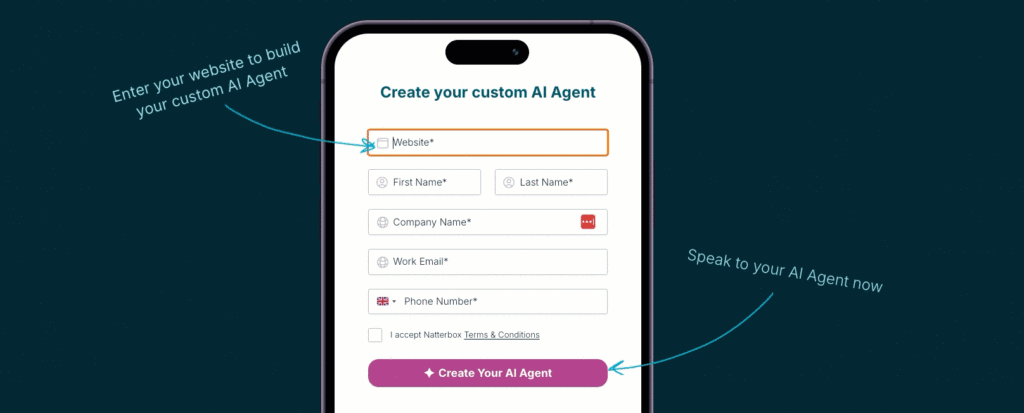
Enter your business website to activate your custom AI Agent. Within 60 seconds, you’ll be able to phone in and have a real conversation.
Role-play as a customer or a lead for your business, and hear it in action.