
In short
- Businesses that respond to a lead within an hour are up to 60 times more likely to qualify it than one that waits 24 hours or more, and the average business still takes 42 hours to respond
- Being proactive with customers can backfire: Gartner found 82% of B2B customers and 66% of B2C customers contact a business anyway after a one-way automated notification, often to ask something the message could have answered
- The fix isn’t more automation, it’s automation that can actually hold a conversation, on whichever channel the customer picks
- Four scenarios do most of the work today: a web form follow-up, appointment reminders, dispatch updates, and renewal check-ins, all picked because they’re low emotional stakes
- Regulation moves fast and unevenly, so any outbound AI use case has to clear four checks: consent, calling windows, revocation, and control, before it’s worth building
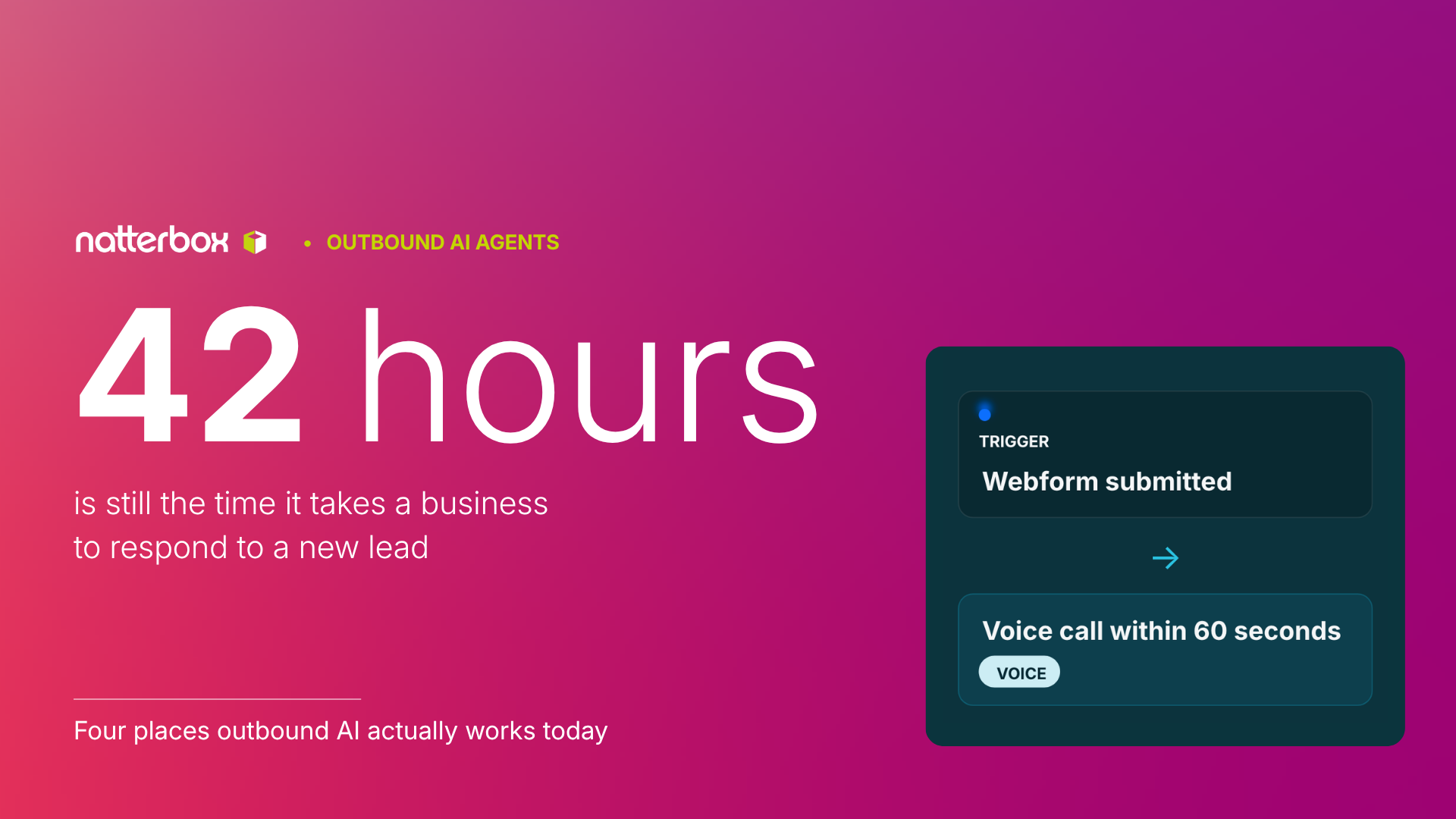
Here’s a number that’s been true for over a decade and hasn’t moved: the average business takes 42 hours to respond to a new lead. Not because nobody’s noticed. Sales teams have known about the speed-to-lead problem for years, and they’ve had exactly two ways to fix it: hire more people to work the phones faster, or bolt on an automation that technically responds but can’t actually hold a conversation. Both come with a cost nobody likes talking about.
Natterbox’s Director of AI Solutions, Simon Woodward, walked through why that’s changing and the research behind why timing matters this much, a live demo of an AI agent actually making the call, and an uncomfortable finding about proactive service that most businesses haven’t clocked yet.
The old choice: burn headcount, or burn trust
Before AI entered the picture, Simon put it plainly: scaling speed-to-lead response meant one of two trade-offs.
“You could either scale to meet this speed at the expense of people’s time working on valuable tasks, or you’d end up with your people only doing the valuable tasks, but less often, because you’re missing out on all the benefits that speed to outreach can have.”
Option one is a power dialler and a bigger team, burning through leads as fast as humanly possible to find the ones worth the time. Option two is a form that locks a meeting booking behind a single yes/no question, available to everyone whether they’re a fit or not. Having spent close to a decade in sales himself before moving into AI solutions, he’s lived the downside of both:
“You’d see an inbound inquiry come in, get booked into a meeting, spend thirty minutes researching their business. You get on that call, and within five minutes they’ve told you they’re in contract for another ten years and just wanted to see what you could do. You’ve wasted all that research time.”
Neither option actually closes the gap between a lead showing interest and someone qualified actually reaching them. That gap is where the real cost sits.
What the research actually says, properly sourced
Three figures anchored the session, and they’re worth separating out, because they come from different places and different years.
Letting a lead book a meeting the instant they fill in a form more than doubles the booking rate, from a 30% industry average to 66.7%, a 36% increase. That’s recent: a 2025 Chili Piper benchmark report, built from four million form submissions. Worth noting it’s vendor data measuring Chili Piper’s own customers, so treat the precise number as directional rather than gospel, though the direction is hard to argue with.
The older, more-cited figure is from Harvard Business Review’s 2011 study, The Short Life of Online Sales Leads: respond to a new lead within an hour and you’re 60 times more likely to qualify it than a business that waits 24 hours or more, still nearly 7 times more likely than one that responds just an hour later. The same study found the average business takes 42 hours to respond. That’s not a typo, and it hasn’t meaningfully improved since 2011.
Put together, the two studies tell a consistent story across 14 years: speed to first contact isn’t a nice-to-have metric, it’s the single biggest lever on whether a lead converts at all.
Being proactive can backfire, and most businesses don’t know it
The more interesting finding in the session wasn’t about speed. It was about what happens once a business decides to get proactive, and gets it half right.
Gartner’s 2022 research into proactive outreach found that businesses who proactively support customers score meaningfully higher on a loyalty-and-spend metric than those who don’t, enough that it’s genuinely worth chasing. The obvious response is to send more proactive notifications: delivery updates, appointment reminders, renewal notices, all automated, all costing no staff time.
Gartner’s less obvious finding is what actually happens next. When that outreach is one-way, a plain notification with no way to ask a question or take action, most customers contact the business anyway. 82% of B2B customers and 66% of B2C customers call back regardless, usually to ask something simple the original message could have answered. You said my delivery’s tomorrow, morning or afternoon? That volume lands on the same support team the automation was supposed to free up.
“Even though on the surface we’re getting the benefits without costing our people time, all of those automations were actually causing a big spike in very basic questions coming back. We’re actually losing a lot of benefit here, because now customers who have a real problem are getting lost in the shuffle of people just following up on that automation.”
The fix isn’t sending fewer notifications. It’s making sure whatever sends the notification can also answer the follow-up, on whichever channel the customer replies on, without a human needing to pick it up. That’s the actual argument for an AI agent over a notification system: not that it’s proactive, but that it’s proactive and conversational.
Four places this actually works today, and why they’re all low-stakes
The session named four scenarios where outbound AI is seeing the most real use: a webform submission getting an immediate follow-up call, appointment reminders becoming confirmation calls, dispatch notifications with tracking, and renewal check-ins running weeks ahead of the actual deadline.
What ties them together isn’t the channel or the trigger. It’s that every one of them is low emotional stakes.
“What I want to do is take low emotional stake conversations, and automate those, and only involve people where I need to.”
A webform follow-up is low-stakes because the person already wants to know more. A renewal check-in 30 days out is low-stakes because nothing’s actually at risk yet. Compare that to a cancellation notice, where a customer’s already decided to leave and the call needs real emotional judgement, not a script. That one stays with a person. The pattern isn’t “automate everything you can,” it’s “automate the conversations that don’t need a human’s judgement, so the humans have time for the ones that do.”
| Scenario | Trigger | Why it’s low-stakes |
|---|---|---|
| Lead follow-up | Webform submission | The person already wants to know more, this is qualification, not persuasion |
| Appointment reminder | Upcoming booking | A confirmation call, not a negotiation |
| Dispatch update | Order shipped | Factual status, nothing to resolve |
| Renewal check-in | 30 days before renewal | Catches risk early, before it’s an actual at-risk conversation |
The part most teams skip: will this still be legal in six months?
Every one of those four scenarios shares something else: they’re all genuinely easy to get consent for. That matters more than it sounds, because outbound AI regulation is moving fast, and unevenly, across different markets.
“What you don’t want to do is burn time building out this wonderful automation that’s going to achieve all the things we’ve talked about, and then in three months’ time find out the regulations mean that agent’s not applicable anymore.”
Using the US as the example, regulators are largely folding AI voices into existing robocall and spam-call law rather than writing new rules from scratch, which means any outbound use case needs to clear four checks before it’s worth building:
- Consent: explicit, trackable, timestamped, and retained
- Calling window: a controlled window, not just permission to call whenever the automation fires
- Revocation: a working, nuanced way for someone to opt out, not just one preprogrammed keyword
- Control: the ability to cap frequency and prevent the same person getting called repeatedly, simply because the technology could
None of this is a reason to hold off. It’s a reason to pick use cases, like the four above, where consent and control are straightforward rather than an afterthought.
What it actually looks like
Watch this live demo run on Simon’s own test lead rather than a real customer deployment. A webform submission, triggered through a standard Salesforce Flow, kicked off an outbound call within seconds. The AI agent introduced itself, got a polite “now’s a bad time,” and immediately offered to text a booking link instead, continuing the conversation on a different channel without losing the lead. Every part of that interaction, the call summary, the SMS thread, the outcome, wrote back onto the Salesforce record automatically, sitting in the same reports and dashboards as a human-handled interaction.
That’s the mechanism behind every figure in this piece: not a single clever call, but a system where the trigger, the conversation, and the record are the same connected thing, built on Salesforce Flow rather than a separate platform bolted on beside it.