The old model of global customer support (hiring native speakers for every target language or relying on clunky, high-latency translation layers) is mathematically unsustainable.
For years, “multilingual support” meant one of two things: expensive specialized BPOs or a robotic voice that paused for three seconds to translate “Hello” into “Hola.” Neither is acceptable in 2026.
The new standard for multilingual conversational AI isn’t just about converting words from one language to another. It is about “cultural fluency” and agentic capability. It’s the difference between a bot that translates a refund request and an AI agent that understands a frantic customer speaking “Spanglish,” calms them down using local cultural norms, and actually processes the refund inside Salesforce without human intervention.
If you are evaluating best agentic AI tools with multilingual support this year, the benchmark has moved. Here is what separates the true polyglots from the basic translators.
The Shift: From “Translation” to “Agentic Fluency”
In 2024 and 2025, the focus was on Large Language Models (LLMs) that could generate text in multiple languages. In 2026, the focus is on Agentic AI—systems that can perceive, reason, and act.
For a global contact center, this distinction is critical. A generative AI model can tell a customer in German how to reset their password. An agentic AI model can reset the password, verify the user’s identity via voice biometrics, and log the interaction in Salesforce, all while navigating the nuances of German formal address (Sie vs. Du) based on the customer’s tone.
This capability decouples revenue growth from headcount growth. You no longer need to hire a new team in DACH (Germany, Austria, Switzerland) just to handle Tier-1 support volume. You simply deploy a German-fluent Virtual Team Member.
The 2026 Buyer’s Checklist: 5 Tests for Multilingual Agents
When vendors pitch their “global” capabilities, use this checklist to cut through the marketing noise and test their operational reality.
1. The “Code-Switching” Test
Real humans rarely speak in perfect, textbook sentences. They switch languages mid-sentence (“I need to return this, pero no tengo el recibo“).
- The Fail: The bot gets confused, asks the user to repeat, or forces them to choose “English” or “Spanish” at the start and strictly enforces it.
- The Win: The AI agent handles code-switching fluidly, understanding the intent regardless of the language mix, just like a bilingual human agent would.
2. The Latency & Localization Test
Translation adds time. In voice interactions, a delay of even 1.5 seconds feels like an eternity, leading to customers talking over the bot.
- The Fail: The signal bounces from the caller to a US server, to a translation API, back to the US, and then to the caller.
- The Win: The solution uses a global telephony backbone to process voice data at the edge, minimizing lag. It feels like a conversation, not a walkie-talkie exchange.
3. The “Data Sovereignty” Validator
This is the single biggest risk for the Economic Buyer (P1A) and Technical Validator (P3) in global organizations. If a French customer’s voice data is processed or stored on a server in Ohio without proper controls, you may be violating GDPR.
- The Fail: A “black box” AI that processes everything in a single default region.
- The Win: Granular control over where voice data is processed and stored. You need the ability to define recording retention policies by region, ensuring compliance with GDPR, CCPA, and local banking regulations.
4. The Salesforce-Native Architecture
Most “multilingual” tools are third-party apps that sit outside your CRM. They might translate the chat, but they dump a messy, unformatted text block into the case notes.
- The Fail: Support agents have to log into a separate portal to see the transcript, or the data syncing breaks due to API limits.
- The Win: The AI is Salesforce-native. The German transcript, the English translation, and the sentiment analysis are all stored directly on the Case or Contact record in Salesforce. This ensures your reporting on “Customer Happiness” (CSAT) is accurate across all regions, not siloed by language.
5. Configurable Cultural Tone
A Japanese customer expects a different level of deference and formality than an American customer. A direct translation of an American apology might sound rude or insincere in Tokyo.
- The Fail: A single “brand voice” that sounds American-centric, translated literally.
- The Win: The ability to configure prompts and persona styles for specific languages, ensuring the feeling of the brand is consistent, even if the words change.
Top Agentic AI Tools with Multilingual Support (2026 Landscape)
The market is crowded, but solutions generally fall into two buckets:
- The Broad Generalists (e.g., Microsoft Copilot, generic LLMs): Excellent at text generation and broad knowledge. They are powerful “brain” engines but often lack the telephony infrastructure to handle low-latency voice at scale or the deep Salesforce architecture to trigger complex workflows securely5.
- The Native Specialists (e.g., Natterbox): Built specifically for Salesforce-centric contact centers. These tools prioritize the “plumbing”—voice quality, routing, and data security—while leveraging the best AI models for language processing.
How Natterbox Delivers “Native” Fluency
At Natterbox, we don’t just “integrate” with Salesforce; we live inside it. For global teams, this distinction matters.
We approach multilingual AI not just as a translation task, but as an operational asset.
- Global Infrastructure: We utilize a global telephony network to ensure low-latency connections, whether your customer is calling from London, Sydney, or São Paulo.
- Secure by Design: We give you control over recording and transcription policies, ensuring you can meet data residency requirements without sacrificing AI utility.
Actionable Intelligence: Because we are native, our AI agents don’t just talk; they act. They can update Salesforce records, route calls based on real-time sentiment, and tag cases with “churn risk” signals—regardless of the language spoken.
Ready for a Conversation?
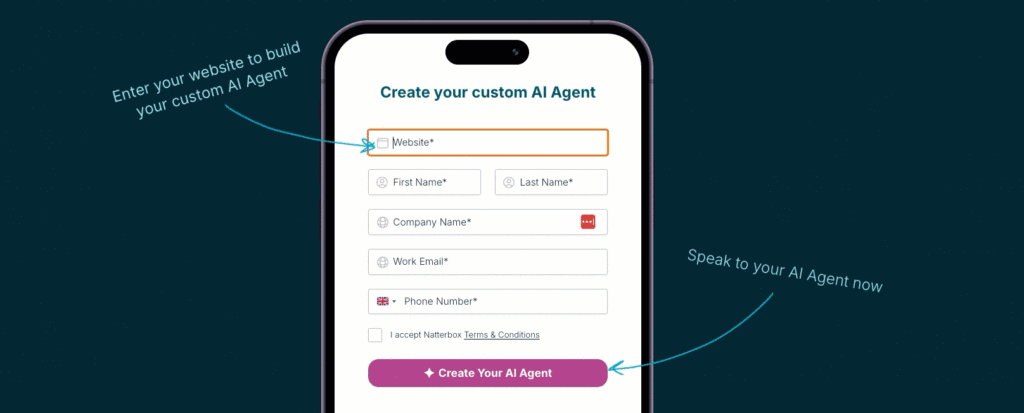
Now you know how Multilingual AI agents work, try it out for yourself. Enter your business website to activate your custom AI Agent. Within 60 seconds, you’ll be able to phone in and have a real conversation. Role-play as a customer or a lead for your business, and hear it in action.